How Much Screen Time Should a 10-Year-Old Have? What the New AAP Guidance Says
If you've been counting minutes and still feel like you're losing the screen-time battle, here's some good news: the experts have moved away from a magic number. What matters most is the plan your family makes together.
What changed in the 2026 AAP guidance
In February 2026, the American Academy of Pediatrics (AAP) released updated guidance on kids and screens. One of the biggest shifts: it no longer centers on a set daily limit. Instead, it encourages families to set boundaries together through a family media plan, and it acknowledges that devices and apps are designed to hold attention, so the responsibility shouldn't rest on parents alone.
That's a relief for a lot of parents. A fixed number never fit real life anyway. A rainy Saturday, a long car ride, and a school night are not the same day.
What that means for kids 8–12
Ages 8–12 are a big transition. Kids want more independence, friends are starting to game and text, and screens show up in homework too. Rather than chasing a number, focus on what screens should not crowd out:
- Sleep: devices out of the bedroom and off well before bedtime.
- School and homework: work first, fun screens after.
- Movement: sports, outside play, or a family walk most days.
- Family time: device-free meals are an easy place to start.
- Hobbies and friends: time to build, create, read, and play in person.
If those five things are protected, the exact number of minutes matters a lot less.
How to build a family media plan in 20 minutes
Sit down together. Kids follow plans they help make. Talk through these five parts:
- 1. When: which days and times screens are for fun (for example, after homework on school nights, a longer block on weekends).
- 2. Where: where devices live, such as a family charging spot in the kitchen, not bedrooms.
- 3. What: which games, shows, and apps are OK. Check reviews together on sites like Common Sense Media.
- 4. How it ends: one heads-up before screen time is over and a stopping point agreed in advance.
- 5. What comes next: the activity your child will do after screens, so “I'm bored” has an answer.
A sample plan for a 10-year-old
School days
- No screens before school
- Homework and chores first
- One fun-screen block after dinner, ending 1 hour before bed
- Devices charge in the kitchen overnight
Weekends
- A longer screen block in the afternoon
- At least one outside or family activity each day
- Family game night or movie night, together
- Device-free meals
Notice what this plan doesn't do: it doesn't ban screens, and it doesn't count every minute. It protects the things that matter and makes screen time predictable, which is what cuts down the arguments.
Signs it's time to reset
Check in if you notice trouble falling asleep, slipping grades, more irritability or meltdowns when devices go off, losing interest in friends or activities they used to love, or very little time moving. Those are signals to adjust your plan, and if you're worried, your pediatrician is a great partner.
Start with one page
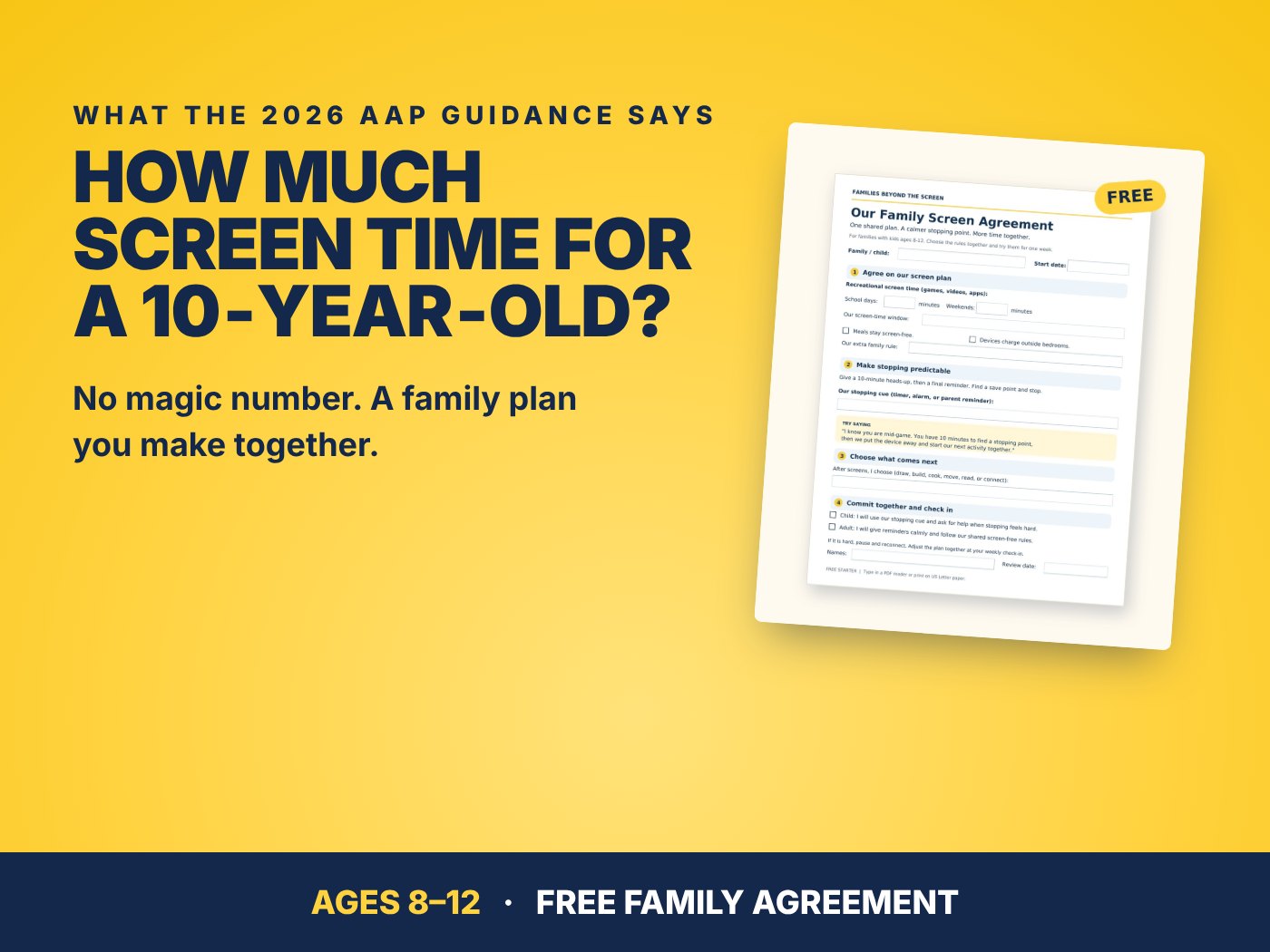
You don't need a 10-page contract. A one-page family screen time agreement covers everything above, and you can make it together tonight.
Source: American Academy of Pediatrics 2026 guidance on children's digital media use, as reported by EdSurge. This article is general education, not medical advice.
Get the free one-page agreement
Everything in this article is on one printable, fillable page: your screen plan, stopping cue, what comes next, and a place for everyone to sign. Enter your email and it lands in your inbox right away.
Email me the free agreementSee the full toolkitQuick answers
How many hours of screen time is OK for a 10-year-old?
In its 2026 guidance, the American Academy of Pediatrics moved away from a single daily number. Instead it recommends a family media plan: decide together when, where, and how screens are used, and protect sleep, school, activity, and family time first.
Did the AAP get rid of the 2-hour screen time rule?
The older two-hour suggestion is no longer the headline recommendation. The 2026 guidance focuses on how families use screens together, the quality of what kids watch and play, and setting boundaries as a family.
What are signs my child is getting too much screen time?
Watch for changes in sleep, schoolwork, mood, friendships, and physical activity. If screens are crowding out those things, or meltdowns happen every time devices go off, it's a good time to reset your family plan, and to talk with your pediatrician if you're concerned.